Tuesday, May 22, 2018

Reflections on Power Washing the Bottom

Seven Months Later No Green Slime

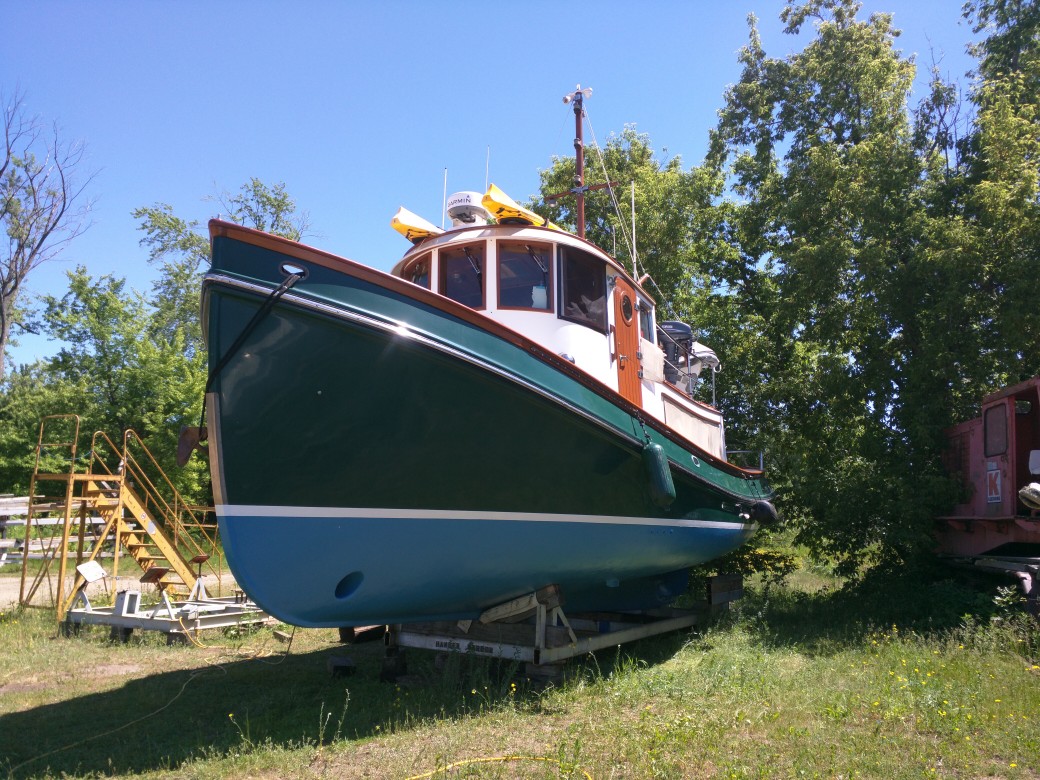
Last fall, after hauling, I elected not to have the bottom power washed.  Not because I have anything against power washing, but rather because I object to paying $200 for a 15 minute job.  I had second thoughts, however, shortly thereafter because as the green bottom slime dried it curdled the ablative bottom paint into a dried-mud-looking patchwork.  Attempts to scrape the bottom clean were futile.  With visions of having to sand the whole mess off in the Spring we left Nellie for her Winter hibernation on the hard.  The intervening seven months gave me plenty of time to ponder the fateful no-power-wash decision.  The saying "penny wise and pound foolish" came to mind.  It was thus with some trepidation yesterday, after returning to Nellie, that I surveyed the hull.  To my great relief the dried-mud-looking patchwork had turned to dust.  Nothing more than a light washing will be required before applying the new bottom paint.  This whole ordeal brings to mind another saying, "Worry is a down payment on a bill that may never come due."  

Sunday, November 26, 2017

Revisited: Cummins Water Temperature Sending Unit

I ordered and installed the following:  

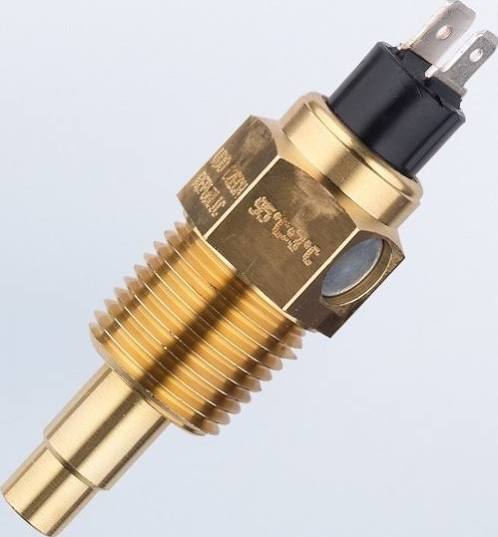
VDO 323-478 - 1/2-14 NPT - Single Channel - Floating Ground Ground 250F / 120C Temperature Sender
It works fine but, it doesn't support an over-temperature warning alarm. 
The unit below reads temperature and grounds-out the alarm lug when the temperature exceeds 205°F. 

VDO 323-098 - 1/2-14 NPT - Spade - 205F+/-5F - Single Channel 250F / 120C Temperature Sender
Since 'grounding of the alarm lug' is exactly how the Cummins 4BT low oil pressure alarm works, we can connect the over-temp lug to this circuit.  Now the low oil pressure alarm will also sound when the engine's cooling water goes over temperature. 

Sunday, July 9, 2017

VDO Sending Units

Nellie's water temperature gauge has recently started reading 210°F when the IR temperature gun is reading 180°F.  To say this is disconcerting is an understatement.  Here's my temporary solution.

Yep, just cover the darn thing with a piece of paper. 

Another anomaly has to do with the oil pressure gauge, it's reading about 5 psi low and the needle is quaking.

The Cummins 4BT-3.9M came equipped with VDO instruments.  Among Nellie's spares is a VDO water temperature gauge.  I suspect it's there because a former owner bought it while diagnosing a sender unit/gauge problem.  The sending unit was at fault so the gauge became a spare.

I've ordered new water temperature and oil pressure sending units in the hope that they'll fix Nellie's problems.  

eGauges.com

P/N 360-009 VDO Oil Pressure Sending Unit
P/N 323-478 VDO Water Temperature Sending Unit

Friday, June 9, 2017

New Thruhulls and Seacocks

Last year the seacock that supplies Nellie's foredeck washdown and galley hand pump got very hard to move.   This year two Lord Nelsons reported seacock failures.  It was time to take a good look at Nellie's.

Nellie has five underwater seacocks:
1)  1-1/4" main engine raw water
2)  3/4" generator raw water
3)  3/4" supply for both the foredeck washdown and galley hand pump
4)  1-1/4" toilet pumpout 
5)  1-1/4" galley sink drain

  The seacocks were bedded? in a black polysulfide caulk.  The same caulk that OEY used extensively.  The caulk was still pliable, waterproof and, best of all, didn't greatly resist part removal.

I found the OEY original Cheng Wei seacocks to be perfectly serviceable.  There was some mineral buildup but that was removed in a phosphoric acid bath.  Still, the seacocks were 30 years old.  It was time for them to go.

We installed Groco FBV Bronze Full-Flow Tri-Flange Seacocks.

These have the advantage of being through-bolted to the hull.  The thruhulls were also replaced. 

The thruhulls had to be cut to length.   For adequate strength, each thruhull should be screwed into its seacock so that at least four full threads are in contact. 

Since there's about 1-1/4" of thread on the inside of the seacock, the thruhulls were cut 3/4" longer than the hull's thickness.  This easily exceeds the four thread minimum.

The supplied thruhull nut was used to guide the blade.

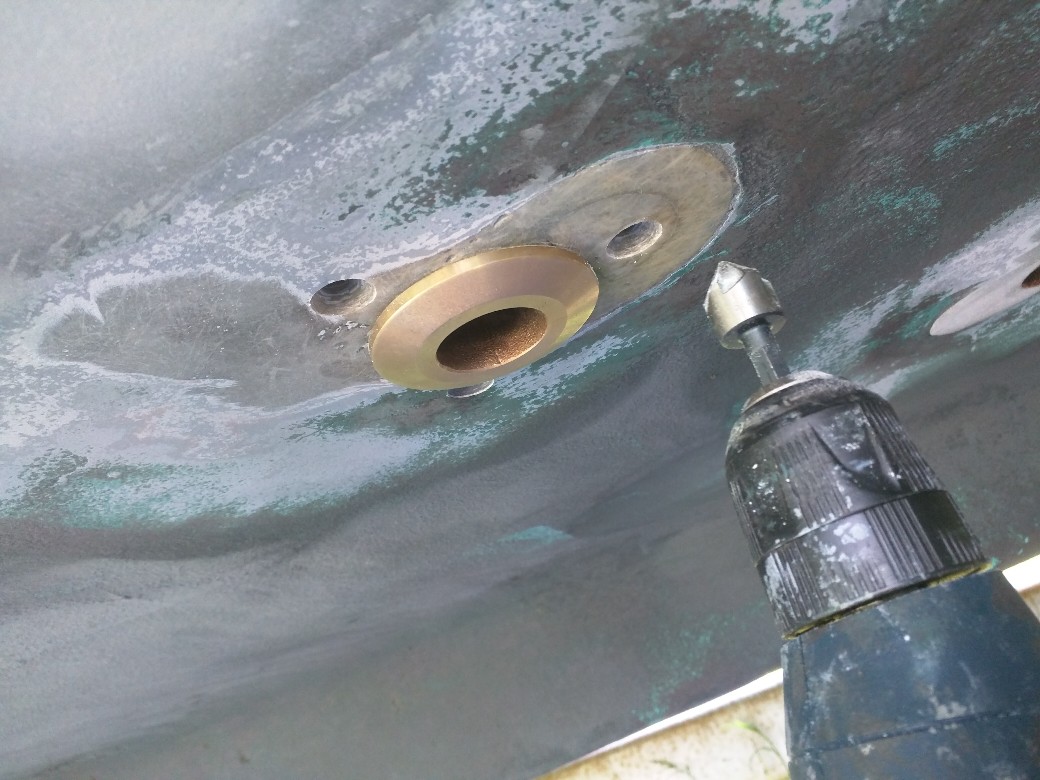
5/16 x 2" stainless steel, Phillips, flat head, machine screws, lock washers and nuts were used on each seacock.  The screw heads were countersunk into the fiberglass.  The screws were cut so that not a lot of extra length protruded into the tug.

All the parts were bedded in white BoatLife (polysulfide).  It took about 1/2 of a cartridge to do the five thruhulls and seacocks. 

Replacing the seacocks and thruhulls isn't an easy job, the first time anyway, but it's definitely one worth doing.  There are at least two distinct safety benefits of doing this job.  First, through-bolted seacocks are much less likely to have a failure which sinks the boat.  Second, I now well know where all the underwater seacocks are located. 


Thursday, June 8, 2017

Nellie is Feet Wet

As the picture below shows, we've taken so much stuff off Nellie that she tried to float away.  Fortunately the trailer she was strapped to was heavy enough to keep her earthbound.
Immediately after splashing, and with some trepidation, I checked the five new seacocks.   The galley seacock was wet...  Fortunately, the problem was resolved by simply tightening the two hose clamps that connect the seacock to the sink's drain hose.
  

Wednesday, June 7, 2017

Diver's Dream Zinc Mount

I worry about the 14mm nuts being so hard to get off that the stud rotates (which nessisitates a bunch of work resealing the hole through the hull).  To slow animal and mineral fouling of the threads Rector's TPLUS2 was applied.  We'll see if the experiment works.

Bootstripe and Bottom Paint


Re-coated the running gear, new thruhulls and the hull patch (the area where the legacy transducer was removed) with Interlux 2000.
The bootstripe was next.  Rustoleum Gloss White has become our go-to enamel.  After sanding and blue-taping the bootstripe two coats were applied.
Used three gallons of Interlux ACT to put two coats on the hull and a third coat on the waterline.  There's even enough left to cover the boat-stands' bare spots.
Had great luck using 4' rod extenders ($2.77/ea. from Walmart) on the paint roller handles; didn't have to crawl under the boat as much.